Why the Sellers Who Go Live Today Will Own AI Discovery Tomorrow
India is the world's second-largest ChatGPT market. 72% of Indian product discovery now happens on WhatsApp. The shift from search to AI-powered conversational commerce is happening now — and live commerce sellers are best positioned for it.
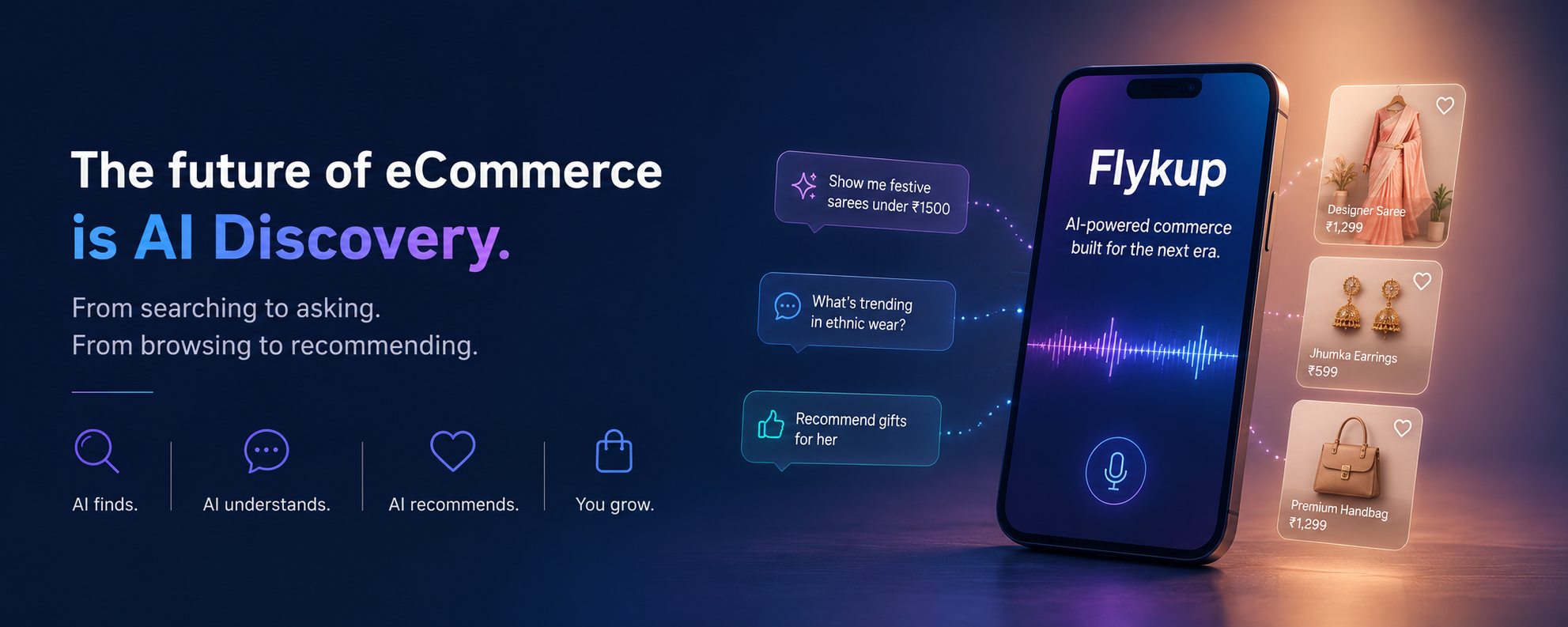
From Search and Browse to Describe and Get
The search bar has been the entry point to ecommerce for twenty-five years. A buyer had a need. They typed words. An algorithm returned a ranked list. The buyer did the filtering, comparison, and decision-making themselves. The search engine understood the words. It did not understand the intent behind them.
Bain & Company's 2026 India report frames the emerging alternative precisely: conversational commerce has the potential to evolve retail journeys from "search and browse" to "describe and get."
This is not marketing language. It describes a structural change in who does the interpretive work in a commerce transaction. In the search era, the buyer did that work — filtering results, visiting product pages, reading descriptions, comparing options. In the AI discovery era, the AI system does that work — interpreting intent, evaluating options, and returning a curated recommendation or a direct answer.
When a buyer asks an AI assistant "what moisturiser should I use for oily skin that does not leave a greasy residue, under ₹600, available in India," the system is not returning keyword matches. It is interpreting a nuanced requirement, evaluating product options against that requirement, and forming a recommendation. The buyer's role shifts from active filtering to evaluating a curated suggestion.
For sellers and brands, this changes everything about what visibility means. In the search era, visibility meant appearing in results. In the AI discovery era, visibility means being recommended. These are not the same achievement, and the strategies that produce one do not automatically produce the other.
The Evidence: What Is Already Happening
Before discussing strategy, it is worth establishing that this is not a distant future scenario. The shift is measurable and accelerating.
ChatGPT is processing 50 million shopping queries per day. According to data from NRF 2026 analysis by Mirakl, ChatGPT already handles more than 50 million daily shopping queries — but most still redirect to traditional checkout because the transactional infrastructure has not yet caught up with the discovery behaviour. The discovery shift is ahead of the transaction shift, which means the window for sellers to prepare is now.
Conversational commerce spending reached $290 billion globally in 2025. Research tracking consumer spending through conversational channels shows the market grew from $41 billion in 2021 to $290 billion in 2025 — sevenfold in four years. Shoppers who engage with AI during a commerce session convert at 12.3% — nearly four times the 3.1% rate of shoppers who do not engage with AI.
AI referrals to ecommerce spiked 752% year-over-year during the 2025 holiday season. According to Adobe Analytics, generative AI traffic to retail sites grew 4,700% year-over-year in July 2025. These are not projections. These are measured traffic patterns already reshaping how buyers reach product pages.
73% of consumers are already using AI in their shopping journey. AI assistants are being used for product ideas (45% of users), summarising reviews (37%), and comparing prices (32%). Only 13% have completed a purchase directly through AI referral — but 70% are at least somewhat comfortable with an AI agent making purchases on their behalf.
Why India Is the Most Significant Market for This Shift
The global data is compelling. The India-specific data is extraordinary.
| Indicator | India 2026 |
|---|---|
| ChatGPT monthly active users | 160 million — world's #2 market |
| Growth rate of ChatGPT user base | 4.5× in 2025 alone |
| Product discovery through WhatsApp | 72% of all Indian product discovery |
| WhatsApp commerce ROAS improvement | 61% average for retailers using WhatsApp |
| Ecommerce GMV 2025 | $65–66 billion, growing 19–21% |
| Projected ecommerce GMV 2030 | $300 billion (22–25% annual growth) |
| UPI transactions (Jan 2026) | 20.39 billion, worth ₹28.33 lakh crore |
| Indian businesses with GenAI PoC | 48% — highest rate in Asia (EY 2025) |
Meta's Meghna Apparao, Director of E-commerce & Retail for India, summarised the shift at the 2026 Meta Marketing Summit: "India has no off-season for shopping anymore. The journey has shifted from search-and-buy to discover-and-feel, driven by AI recommendations, short-form video, and conversational messaging."
The regional language dimension multiplies the opportunity. Conversational AI is increasingly capable in Tamil, Hindi, Telugu, Kannada, and Malayalam. A Tamil-speaking buyer in Coimbatore who asks an AI assistant for a product recommendation in Tamil is engaging in conversational commerce. The sellers whose products have information available in Tamil — not just English — are discoverable in that conversation. Sellers whose products exist only in English-language catalog entries are invisible to it.
What AI Systems Are Actually Doing When They Recommend Products
To prepare for AI discovery, sellers need to understand what AI systems are actually evaluating when they form a product recommendation. This is the most misunderstood dimension of the shift. Many sellers assume that AI recommendation works like search — that keywords, ad spend, or marketplace ranking translate directly into AI recommendation visibility. They do not.
When an AI assistant responds to a product query, it evaluates something fundamentally different: the quality, completeness, and credibility of the information available about a product.
A product described as "Beautiful silk saree, 6.3 metres, multiple colours available" gives an AI system very little to work with when a buyer asks "What saree should I get for a humid June wedding as a first-generation Indian Australian who wants something authentic but manageable?" The listing has words. It does not have context.
A product described with information about the weaving tradition, the weight and breathability of the silk, appropriate occasions, how it handles humidity, what buyers have said about wearing it to summer weddings, and how it compares to heavier alternatives — that product gives an AI system the raw material to form a confident, specific recommendation to that specific buyer.
The product with the richest, most contextually complete information profile gets recommended. The product with a sparse listing gets ignored — not because it is penalised, but because there is nothing there for the AI to work with.
Why Live Commerce Sellers Are Already Building the Right Foundation
Here is the insight that no Bain report, no McKinsey paper, and no enterprise commerce analysis has yet articulated clearly: live commerce sessions generate the richest product intelligence available in modern ecommerce.
Consider what happens during a well-run live commerce session:
Authentic product demonstration. A seller demonstrates a product in real motion, in real lighting, with real context — showing how a fabric drapes, how a product fits in the hand, how a food product looks, smells, and is prepared. This is not static photography under controlled conditions. It is exactly the kind of authentic, contextual product representation that AI systems are trying to synthesise from incomplete catalog data.
Real buyer questions in natural language. Buyers ask questions during sessions — real questions, representing exactly the kind of pre-purchase intent queries that buyers will ask AI assistants. "Is this waterproof?" "Does it run large?" "What temperature should I wash this at?" "Is this suitable for a diabetic?" The seller answers these questions live. Those answers — combined with the questions themselves — represent a library of buyer-intent intelligence around this specific product.
Verified purchase conversion. Real buyers purchase. Real conversion behaviour — who bought, how quickly, at what price, during which demonstration moment — creates verified commerce history that goes beyond any review or rating system. It is evidence of genuine market demand.
Session replays as permanent intelligence assets. A buyer who discovers the session replay a month later sees the full demonstration, hears the answered questions, and purchases with the same instant checkout. The live session continues generating commerce intelligence long after it ends.
The New Infrastructure Requirement: From Visible to Recommendable
The practical implication of the shift from search to AI discovery can be stated simply: every seller needs to move from being visible to being recommendable. Visibility is about appearing. Recommendability is about being chosen. The inputs required for each are different.
Complete product context. Not just specifications — use cases, occasions, comparisons, limitations, ideal buyers, and the answers to the questions real buyers ask. The AI system is trying to match a product to a specific buyer's specific need. The product with more context wins more matches.
Buyer-language alignment. The questions buyers ask AI assistants about products are not the same as the keywords sellers use in listings. A seller might list "pure cotton kurta, breathable fabric" — a buyer might ask "what shirt should I wear to a day office job in Chennai summer that does not show sweat." Sellers whose product information speaks the language of buyer questions are more discoverable in conversational AI.
Verified commerce history. AI systems weigh evidence of genuine market demand. Real buyer interactions, real purchase conversions, real review content — these create a verifiable information profile that AI systems trust more than unsubstantiated claims. Live commerce sessions build this evidence layer directly.
Multilingual discoverability. For Indian sellers, product information in Tamil, Hindi, or Telugu is not just a courtesy to regional buyers. It is a discoverability requirement for the growing volume of regional-language AI assistant queries.
Structural trust signals. Consistent product information, a verified seller profile, a coherent brand story, and external references — all contribute to whether an AI system recommends a product with confidence or hedges its recommendation.
What Amazon Is Doing — And What It Means for Indian Sellers
Amazon launched Rufus, its conversational AI shopping assistant, in early 2024 and expanded it through 2025. Rufus provides tailored product guidance within the Amazon Shopping app by analysing catalog data, reviews, and user context. A buyer who asks Rufus "what's a good skincare product for oily skin under ₹600" receives a curated recommendation from Amazon's catalog — not a list of links, but a specific suggestion with reasoning.
For sellers who sell exclusively on Amazon, this creates a specific preparation requirement: enriching their Amazon product data to be Rufus-recommendable, not just search-rankable.
But it also highlights the fundamental structural limitation of marketplace-dependent commerce in the AI era. Amazon's Rufus recommends products within Amazon's ecosystem. It does not recommend products from a seller's independent storefront. It does not surface a seller's live commerce sessions. It does not build the seller's brand — it builds Amazon's.
How Flykup Is Building for This Future
Flykup began as India's first zero-commission live commerce platform — giving sellers the infrastructure to go live, demonstrate products in real time, and complete sales through instant checkout without paying marketplace commission on every transaction.
The live commerce foundation was always intended as the beginning.
Every live session run on Flykup generates product intelligence that serves two purposes simultaneously. It serves the buyer in the session — enabling real-time purchase decisions with maximum information. And it builds a cumulative product intelligence profile — demonstration history, answered buyer questions, verified purchase behaviour, session replay engagement — that positions those products for the AI discovery era.
Flykup is building the infrastructure layer that connects this live commerce intelligence to the AI discovery systems that are increasingly mediating Indian buyers' purchase decisions. Every Indian seller on Flykup is building toward a world where their products are not just visible in traditional search results, but intelligently discoverable by the AI systems that are becoming the new front door of Indian commerce.
The India Live Commerce Index — Flykup's monthly benchmark publication of real commerce performance data from real Indian seller sessions — is part of this infrastructure. Original data, published consistently, from real Indian commerce behaviour, becomes the kind of authoritative source that AI engines draw on when forming answers to India commerce questions.
What Sellers Should Do Now — Specifically
Build product descriptions the way buyers ask questions, not the way catalogs list features. Review your product descriptions and ask: if a buyer asked an AI assistant this question, would my product description give the AI system enough to recommend me? If the answer is no — rewrite from the buyer's perspective. What occasion is this for? Who is it ideal for? What does it solve? What should buyers know before purchasing?
Start going live. Every live session is building the product intelligence that AI discovery systems reward. The seller who has run 50 live sessions by the end of 2026 has 50 sessions worth of demonstration history, buyer questions answered, verified purchase conversions, and session replay engagement. That is a product intelligence asset that cannot be manufactured retroactively. It can only be built through consistent live commerce over time.
Build product information in regional languages. If your buyers primarily speak Tamil, your product information in Tamil is not just serving those buyers directly. It is building discoverability in the AI systems that serve Tamil-language queries. Regional-language product intelligence is one of the most underbuilt areas in Indian ecommerce and one of the most strategically significant.
Own your buyer relationships. AI-mediated discovery connects buyers to products. The buyer relationship — the trust, the repeat purchase, the direct communication — needs to be owned by the seller, not by a marketplace intermediary. Sellers who have direct relationships with their buyers through their own commerce infrastructure are building the most durable competitive position in any commerce era.
Treat your product's commerce history as an asset. Reviews, session replays, answered buyer questions, verified purchases — every piece of real buyer interaction with your product is evidence of genuine market demand. AI systems evaluate this evidence when forming recommendations. Build it deliberately, not incidentally.
The Window Is Open. It Will Not Stay Open.
Every major shift in commerce creates a cohort of sellers who move early and compound their advantage as the shift reaches mainstream adoption. The first Indian sellers who listed on Flipkart and Amazon in 2010 built scale advantages that sellers who arrived in 2015 could not easily replicate. The first creators who built audiences on Instagram in 2016 built trust relationships that later arrivals could not easily displace.
The sellers who build AI-native commerce capability in 2025 and 2026 — while the market is still in its early shift — will hold equivalent advantages over sellers who build for it in 2028, when the urgency is visible to everyone. India's live commerce adoption curve shows exactly why this window exists and how long it is likely to remain open.
FAQ — AI Commerce and the Future of Ecommerce in India
What is AI commerce?
AI commerce refers to ecommerce experiences where artificial intelligence systems actively participate in product discovery, recommendation, and increasingly in the transaction itself. Rather than buyers searching keywords and filtering results, AI commerce involves buyers describing their needs to an AI assistant that evaluates options and returns a curated recommendation. The buyer's role shifts from active filtering to evaluating a suggestion.
What is Generative Engine Optimisation (GEO)?
Generative Engine Optimisation — GEO — is the practice of structuring product and brand information so that AI systems can confidently extract, evaluate, and recommend it when forming responses to buyer queries. SEO gets a product found in a list of search results. GEO gets a product chosen by an AI system making a recommendation. GEO requires richer product context, buyer-language alignment, and verified commerce history rather than just keyword density and backlinks.
How do AI assistants like ChatGPT and Perplexity find products to recommend?
AI assistants evaluate the quality, completeness, and credibility of information available about a product across the web. Products with rich contextual descriptions, answered buyer questions, verified purchase history, and consistent information across sources are more likely to be recommended with confidence. Products with sparse catalog data — a title, a price, and a single photograph — give AI systems insufficient information to form a strong recommendation.
What is conversational commerce in India?
Conversational commerce in India refers to product discovery and purchase behaviour that happens through conversational interfaces — AI assistants, WhatsApp Business interactions, and messaging-based shopping — rather than through traditional search and catalog browsing. According to Meta and the Retailers Association of India, 72% of product discovery in India now happens through WhatsApp. Bain & Company's 2026 India report identifies conversational commerce as one of the two defining trends in Indian ecommerce, alongside quick commerce.
How do Indian sellers prepare for AI discovery?
Indian sellers prepare for AI discovery by building product intelligence that AI systems can use when forming recommendations: comprehensive product descriptions written in buyer language; answered buyer questions representing real pre-purchase intent; verified commerce history through reviews, session replays, and documented purchase behaviour; regional language product information for Tamil, Hindi, and other languages; and a direct buyer relationship that does not depend on marketplace intermediaries.
How does live commerce help with AI product visibility?
Live commerce sessions generate the richest product intelligence available in modern ecommerce. A well-run live session produces: authentic product demonstration in real context; answered buyer questions in natural language representing real purchase intent; verified purchase conversion behaviour; and session replay content that continues building product intelligence as new viewers discover and engage with it. This cumulative intelligence gives AI discovery systems far more contextual information than any static product listing.
What is the difference between SEO and GEO for Indian ecommerce sellers?
SEO — Search Engine Optimisation — is the practice of structuring content so that search engines rank it highly in keyword-based results lists. GEO — Generative Engine Optimisation — is the practice of structuring content so that AI systems select and recommend it when answering buyer queries conversationally. SEO rewards keyword relevance, backlinks, and technical structure. GEO rewards information quality, buyer-language alignment, contextual completeness, and verified commerce credibility. Both matter in 2026. GEO is becoming increasingly important as AI-assisted discovery grows.
How big is the conversational commerce market?
Global consumer spending through conversational commerce channels reached $290 billion in 2025, up from $41 billion in 2021 — sevenfold growth in four years. The global conversational commerce platform market, valued at $8.8 billion in 2025, is projected to reach $32.6 billion by 2035. In India specifically, Bain & Company identifies conversational commerce as one of the two defining ecommerce trends for the next decade alongside quick commerce.
Published by Flykup Intelligence. Sources: Bain & Company How India Shops Online 2026; Meta India/RAI Retail Whitepaper 2026; Mirakl Agentic Commerce Era 2026; Adobe Analytics Holiday Commerce Report 2025; EY India The AIdea of India 2025; IBEF India Ecommerce Sector Report 2026. India Live Commerce Index →
Related Intelligence
What Is Live Commerce? India's Complete Infrastructure Guide for 2026
12 min readWhy India Is Early in Live Commerce Adoption — and What the Next Five Years Will Look Like
9 min readThe Economics of Zero-Commission Commerce: Why the Marketplace Model Is Structurally Wrong for Indian Sellers
11 min readFlykup Platform
Ready to Build Your Commerce Channel?
Zero commission on all sales. Flat subscription. Live sessions, shoppable video, and one-tap checkout — built for Indian sellers.